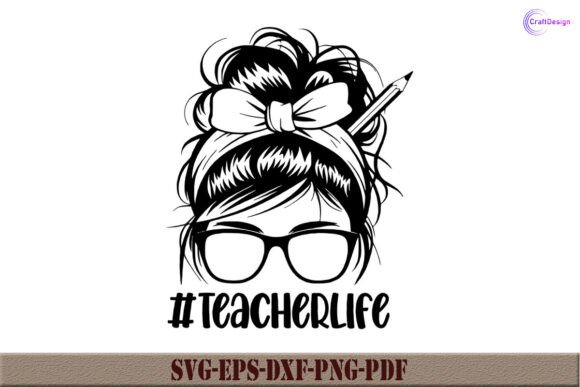
Keep Calm and Teach On: A Sublimation Design Review
As a designer who bridges the gap between digital graphics and tangible textile products, I approach every new asset with a specific question: will this actually work in production? When evaluating Keep Calm and Teach on Sublimation, my perspective shifts from pure aesthetic appreciation to practical application. This design arrives as a comprehensive package including a print-ready PNG at 4500×5400 pixels (300 dpi), along with EPS, SVG, and PDF files. While marketed primarily for sublimation, the vector-based nature of the EPS and SVG formats makes it a compelling candidate for mixed-media projects, including machine embroidery design adaptations and hybrid crafting.
First Impressions and Visual Hierarchy
The "Keep Calm" motif is iconic, but its success relies entirely on execution. Upon opening the high-resolution PNG, the first thing I assess is the line clarity. For an embroidery designer or apparel decorator, crisp edges are non-negotiable. The 300 dpi resolution ensures that if you are using this for direct-to-film transfers or sublimation prints alongside embroidered elements, there will be no pixelation. The layout follows the classic crown-and-text structure, which provides excellent vertical balance. This symmetry is crucial when centering designs on sweatshirts or tote bags, as it naturally draws the eye to the middle of the garment without requiring complex placement calculations.
The typography appears clean and bold, suggesting high legibility even when scaled down. In the realm of Graphics and Crafts, readability is king. If the text is too ornate, it fails as a quick-read message on a teacher’s apron or classroom decor. This design maintains strong negative space between letters, which is a relief for anyone planning to convert this into a satin stitch outline or fill stitch lettering later. The visual personality strikes the right chord of professional yet approachable, making it suitable for both personal use and commercial embroidery projects targeting educators.
Real-World Application: The Teacher Appreciation Tote
To truly judge the utility of Keep Calm and Teach on Sublimation, I mentally placed it into a current project scenario: creating premium teacher appreciation tote bags for an end-of-year boutique collection. My goal was to combine a vibrant sublimated background panel with textured embroidery for a high-value handmade product.
In this context, the design performs exceptionally well as a foundational layer. Because the file is easy to modify, resize, and change, I could scale the PNG to fit a 9x12 sublimation panel perfectly. However, the real test comes when integrating it with physical thread. The bold block lettering of the design allows for easy tracing if one chooses to embroider over the printed text. I envision using a dense fill stitch for the crown to give it weight and texture, while keeping the text as a sublimated element to reduce stitch count and prevent the tote bag fabric from becoming too stiff. This hybrid approach leverages the strengths of the digital file while adding the tactile value of a finished embroidered product.
For Etsy sellers and small shop owners, this versatility is a major asset. You can offer the same design as a purely sublimated t-shirt for a lower price point and as a mixed-media embroidered sweatshirt at a premium tier. The design’s inherent structure supports both business models without losing brand consistency.
Technical Considerations for Embroidery Adaptation
While Keep Calm and Teach on Sublimation is delivered as a graphic, many makers will want to digitize it for machine embroidery. Here is where practical judgment matters. The provided vector files (EPS/SVG) are your best friends here. Unlike raster images, vectors allow you to pull exact node paths for digitizing software, ensuring smooth curves and precise corners.
However, caution is required regarding stitch density. The solid areas of color in the original graphic, if converted directly to full fill stitch, could become bulletproof and distort lightweight fabrics. If adapting this for baby embroidery or thin performance wear, consider using a lighter fill pattern or keeping the main body as sublimation and only embroidering the outline. Always check your stabilizer choice; a cutaway stabilizer is generally safer for knit fabrics like sweatshirts to prevent the design from pulling or puckering after washing.
Thread colors also demand attention. The design likely uses standard royal blue and white, but screen colors differ from thread charts. Before committing to a large run of custom apparel, verify your thread color contrast against the actual fabric. What looks vibrant on a monitor might appear muddy on navy cotton. Testing on scrap fabric is not just a suggestion; it is a mandatory step for maintaining customer trust and product quality.
Navigating Fabric Limitations and Hoop Sizes
Not every surface is friendly to this specific aesthetic. While Keep Calm and Teach on Sublimation shines on flat, stable surfaces like pillow covers, tea towels, and canvas tote bags, it presents challenges elsewhere. Curved surfaces like caps are difficult because the vertical stacking of the text requires perfect alignment; any distortion in the cap's curve can make the centered text look crooked. Similarly, highly textured fabrics like terry cloth or fleece can swallow the fine details of the crown icon unless you use a topping or water-soluble stabilizer.
Hoop size is another critical constraint. The design’s vertical aspect ratio (4500×5400) suggests a tall composition. Makers with smaller hoops (e.g., 4x4) may need to separate the crown from the text or resize significantly. Resizing vector-based graphics is safe, but resizing digitized embroidery files has limits. If you plan to shrink this design for a pocket logo or baby bib, ensure the text remains legible. Tiny lettering often turns into a mess of jumps and trims. In such cases, simplify the design or reserve the full version for larger hoop sizes and adult garments.
Commercial Viability and Professional Presentation
For creative entrepreneurs and digital product sellers, the licensing and presentation of this asset matter as much as the stitch-out. The inclusion of multiple file formats signals professional readiness. The PDF serves as a great printable mockup base for listing photos, allowing buyers to visualize the design before purchase. The high-DPI PNG ensures that your marketing materials look sharp, which directly influences buyer engagement and perceived value.
When selling finished products featuring Keep Calm and Teach on Sublimation, presentation elevates the item beyond generic merchandise. Photographing the product in natural light, showing close-ups of the stitch texture or print clarity, and demonstrating the scale on a real person builds confidence. Customers need to see that the "Teach On" message isn't just a clip-art afterthought but a carefully integrated part of a quality handmade product.
Designer Notes for Successful Execution
Before launching this design into your production queue, adhere to these practical checkpoints:
- Verify Licensing: Confirm whether your purchase includes commercial rights for selling physical items versus digital files. Never assume; always check the specific license terms provided with the download.
- Test Print and Stitch: Run a sample on the exact fabric you intend to sell. Check for color matching and wash fastness.
- Contrast Check: View the design in black and white to ensure the values hold up without relying solely on color differentiation.
- Stabilizer Audit: Match your stabilizer weight to the fabric and stitch density. Heavy designs on light fabric require more support.
- Mockup Validation: Use the provided assets to create realistic previews. Avoid floating designs; show them on actual garments or blanks.
- Resize with Care: Utilize the SVG/EPS for resizing graphics, but re-digitize or adjust stitch parameters if converting to embroidery at extreme sizes.
Ultimately, Keep Calm and Teach on Sublimation is a robust asset for the maker community. Its strength lies in its flexibility and clean geometry, allowing it to transition smoothly from a digital graphic to a cherished personalized gift or boutique staple. By respecting the technical requirements of both sublimation and embroidery, crafters can transform this file into products that resonate deeply with teachers and educators, delivering both style and substance.